

In the middle of the 19th century, a man named George Graham, born 1810 in Ireland, emigrated to settle in Clarke Township. His son George had 11 children, the eldest of whom was my grandfather, Frederick Graham, after whom I am named. Frederick married Lydia Walton in 1907 and lived on the farm located on King Avenue East in what was recently known as “The Gift of Art.”
Anticipating the agricultural bent of his four sons, he was able to purchase the Wilmot estate in 1938 for $8000, surely a challenge in the Depression era. Later, part of the property was sold to the Brown family, whose farm “Browview” was located on the west side of Wilmot Creek.
The Belmont boundaries stretched from Highway 2 on the south to the CPR railway on the north. In the 1950s the Ontario Ministry of Transportation drove a hard bargain in expropriating the land for the cloverleaf at Highways 2 and 115, thereby reducing the size of the farm as well as cutting diagonally through the property in a northeasterly direction to Highway 35. It made farming a challenge, with fields and buildings on the south side, while an orchard with surrounding fields and pastureland were on the north side.
The house itself had gone through several hands, including one Mr. Littlefield, who had business interests in China, and we children were reminded frequently that the wallpaper in the front hallway had been imported from China. In the Great Depression however, Mr. Littlefield suffered financially and moved out very precipitously.
My grandfather never actively tilled the soil at Belmont, but handed the management to my father, Alfred Walton Graham, then aged 30, and then transferring the deed to him before his marriage in 1945 to my mother, Lena Kimball of Port Granby.
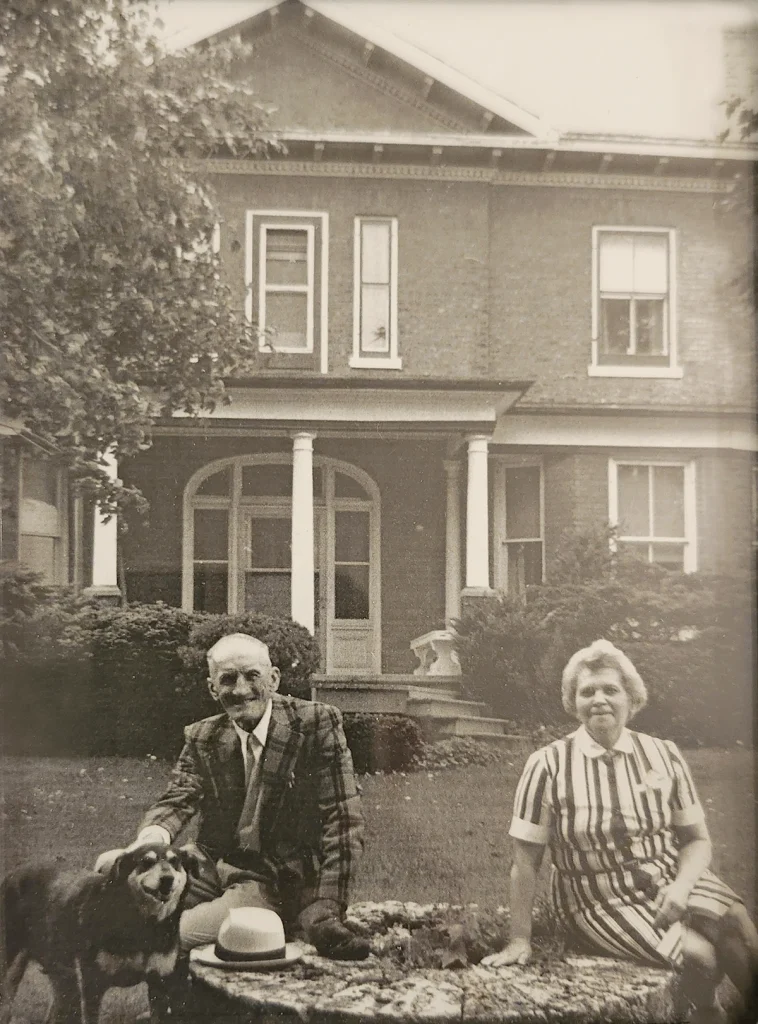
Lena never described herself as a farmer, but we can agree that she too was a farmer. To say their income was modest would be an understatement, and except for their bedroom suite and the player piano which are still in our possession, everything in the house was a hand-me-down.
As a family, we lived in restricted sections of the dwelling: the large kitchen with its cook stove, the east double parlours, and three of the 5 bedrooms on the upper level. In terms of facilities, we had access to one bathroom with a tub, sink and toilet, a second bathroom with a shower, toilet and sink, and a 2-piece washroom on the main level. The water supply had two sources. Drinking water came from the ever-flowing artesian well to the east of the house, water that was visible in a cement tank in the floor of the basement, and soft water was collected in an underground cistern, and as its level depended totally on weather patterns, bathing was allowed only once a week, and showers were quick!
What experiences do I recall from my time at Belmont, 1946 – 1967 when I finished university, and moved to Germany, then Ottawa. . .?
Let me begin in the basement, where there was an octopus of a furnace, barely able to heat the 15-room house, fired by wood chopped by my father, or at other times fired by coal delivered by his younger brother, George Wesley Graham. I still recall winter mornings curled up in my feather tick in bed, hearing the rumble of wood being added to the furnace at 6 a.m., when my father started his day. The basement was cool enough to store a few apples, as well as the annual harvest of potatoes and carrots.
On the main level the kitchen had 8 doors: the pantry, (with its dumb waiter) the back stairs, the hallway, the cellar, the anteroom, the back door, the maid’s stairway, and a coat closet. It was here that the kitchen table, which had 4 leaves, hosted over a dozen hungry helpers at the time of harvest, or family gatherings. It was the room where we as children did our homework, and where we all gathered daily at the radio to hear Gordon Sinclair on CFRB. We did not live in the southwest room at all; it was a playroom or storage area. In the east parlour was the piano, the dining table for occasional use, and after 1963, a television – black and white, of course.
The central grand staircase area was not useful except as transit space, and where children produced costumed plays and musical fantasies. The main front door was not used more than three times a year.
I failed to mention “the back rooms” of the house which were perhaps meant as the summer kitchen, but in fact served as storage areas for machinery, apple boxes and discarded items kept “just in case.” The original 1898 kitchen cupboards, painted bright red, had been moved there, and I own one of them to this day.
My parents once hosted a New Year’s Eve party and dance, using the double parlours on the east side of the house, with a small instrumental group providing the dance tunes. In 1970, my sister’s wedding reception took place in these large rooms. A decade later, my father’s health forced him to abandon farming after 40 years, and pass what remained of the property to Heather Griffin and her family.
In 1986, Alfred and Lena moved to a bungalow on Mill Street south at the end of August, where he died only 7 weeks later. Lena lived in the village and was active with the NVDHS for another 20 years.
While living at Belmont, we were always aware that we were custodians of a slice of Newcastle history, the more so because my father had been Reeve of the area before he was 35. We enjoyed the swimming hole in Wilmot Creek, and I learned to skate on the former fishponds. We caught rainbow trout from the stream, we had fresh produce from the half-acre garden and especially enjoyed the flavour of harvest apples from the single tree in the garden. The external buildings consisted of a chicken house where I collected eggs daily, a driving shed for all the implements, and a two-tier barn, the newer section having been built by my father between 1939 and 1946.
What a privilege it was to grow up with an awareness of things past and things to come, while helping to preserve and gradually improve a small element of Canadian heritage.
Fred Kimball Graham
October 22, 2025 presentation