NVDHS General Meeting Wednesday, April 29, 2026, 7 p.m. Newcastle Community Hall
Katherine Le Gresley, author of the The Lightkeeper Come and hear about the Farncomb family of Ebor House and the influence they had on the town of Newcastle and beyond.
Free admission
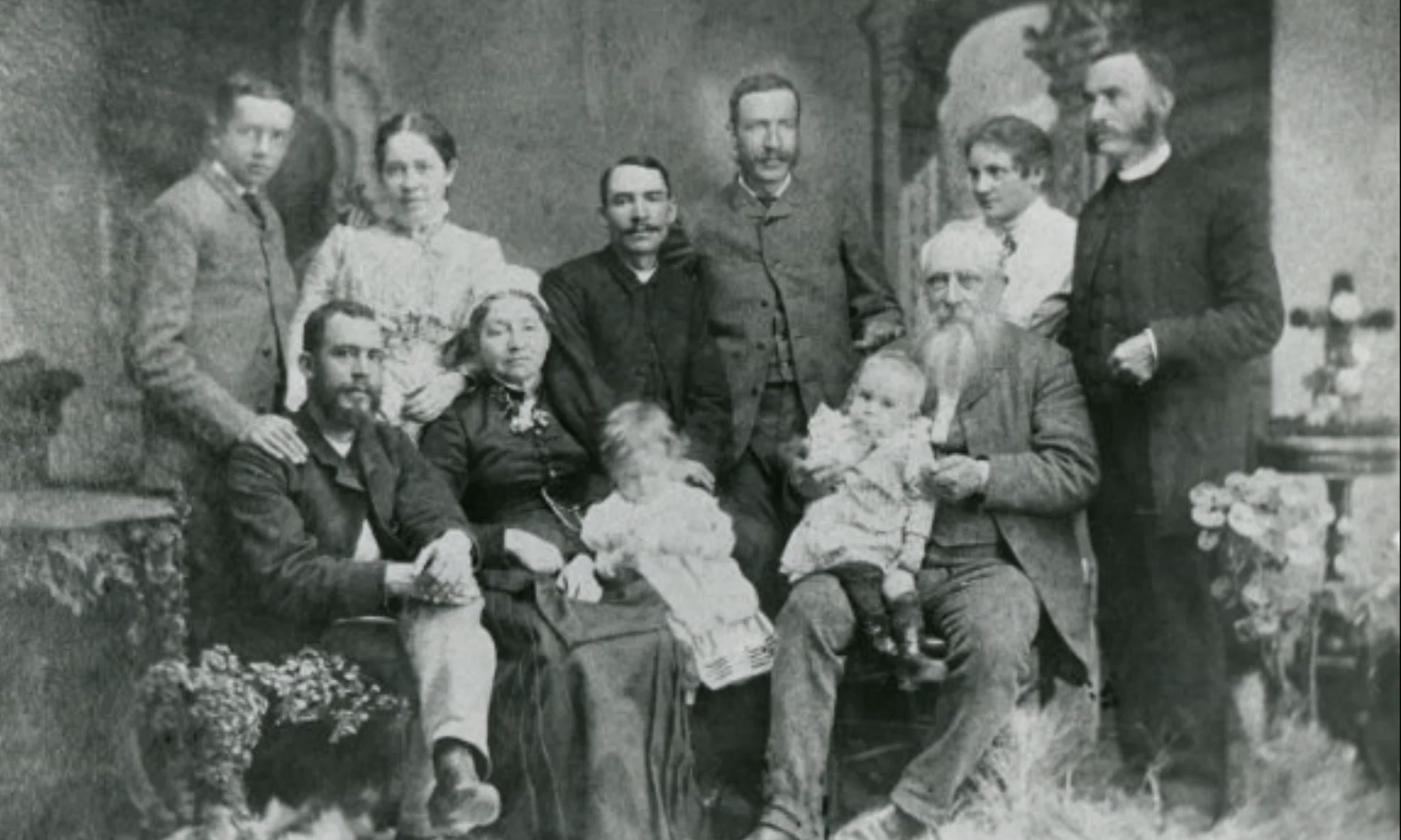
The Farncomb family settled in the Newcastle area in the mid-1800s. Like most families of their time, the Farncombs were very community oriented and dedicated themselves to helping to develop the town and faithfully serve the people in it. Their steadfast influence was felt from the workings of the harbour to the building of St. George’s Anglican Church and the establishment of the town pharmacy. One of the Farncomb boys grew up to become the much loved and respected town doctor while another took on the rectorship of the Anglican church. The other Farncomb boys also pursued careers in medicine and the church.
Dora, however—the only daughter in the family—perhaps had the most far-reaching impact of all. She became a nationally known and cherished author with hundreds of articles and three books to her credit. Notably, she also had a strong impact on Newcastle itself through the establishment of a young men’s social club. For many years after her passing, the group of men affectionately known as “Dora’s Boys” spread throughout neighbouring towns and cities, where they became dedicated and influential members of the communities in which they settled.
Katherine’s talk will look at the life of the Farncomb family from their arrival in Newcastle to the passing of daughter Dora in 1938. It will particularly focus on the lives of the members of the family who played the most influential roles in the history of Newcastle including Frederick (the chief customs officer at the harbour), Alfred (the town doctor), John (the rector of St. George’s Anglican church) and Dora (the author). These, together with their wives and children, are the characters readers will recognize from her 2022 historical novel, :”The Lightkeeper,” which explores the joys and tragedies of the Farncomb family through the eyes of Dora Farncomb.
Saturday, March 28, 2026 at 11 a.m. Historical Room, Newcastle Community Hall
Find out what we’ve been doing for the past year
Elect the 2026-2027 Board of Directors
Participate in our fun and informative Show and Tell
Enjoy a light lunch afterward
The meeting portion will be short and then it will be on to the fun of sharing our interesting items of historical interest. Found some mysterious items when cleaning out the basement at Grandma’s? Or something amazing at a garage sale last summer? Bring it in and share at our very own Newcastle mini “Antiques Roadshow”
Free light lunch.
Hope you can join us!
Don’t forget to renew your membership if you’ve received a notice; you must be a member in good standing in order to vote at the Annual Meeting.
2026 Annual Meeting Agenda
Welcome
Adoption of Agenda
Approval of Minutes of last Annual Meeting – April 12, 2025
President’s Report
Treasurer’s Report
Approve the waiving of a financial audit or review engagement for 2026
Nominating Committee – Election of Board of Directors
Motion to Adjourn
After the meeting is adjourned we will have a “Show & Tell” – so please bring any interesting objects or photos or documents that you wish to share. Following the Show & Tell, we hope you will join us for a light lunch.
Note: financial statements are available upon request not less than 5 (five) days prior to the Annual General Meeting. They will also be distributed at the meeting.
*Thanks to the generosity of one of our members, donations made before January 1, 2026 up to a total of $2500, will be matched.
Join us in raising $5000 by January 1, 2026 to provide support for our digitization project.
Help us promote and preserve Newcastle’s history by making it more accessible to our community and beyond through our ongoing digitization project. With the help of summer students and dedicated volunteers, we’ve been hard at work cataloguing and documenting our collection, but there is still so much more to do.
Our year-end fundraiser is essential to our ability to hire a summer student (or even two!) for 2026, and we hope you’ll consider supporting this effort. Your generosity directly fuels the work you can now explore online: browse our seasonal displays through CatalogIt to see what your donations make possible.
And don’t forget to visit our YouTube channel, where 43 videos are already available — with more on the way as we record interviews with long-time community members and preserve their memories for future generations.
As we look ahead to the New Year with hope and enthusiasm, we would be thrilled to have you join us in making a student position possible for 2026. All donations made before the end of day December 31, 2025, will be matched up to a total of $2,500. Help us raise $5,000 for 2026 and keep Newcastle’s history alive and growing!
We hope you’ll find the time to join us for some treats and holiday cheer this Saturday at the Historical Room.
Saturday, December 13, 2025 9:30 to noon Historical Room, Newcastle Community Hall
Come and enjoy lots of free yummy holiday treats, mulled cider, tea and coffee, and music. We hope you’ll drop by to join in the fun. Open to all – bring a friend! We’re looking forward to seeing you!
In the middle of the 19th century, a man named George Graham, born 1810 in Ireland, emigrated to settle in Clarke Township. His son George had 11 children, the eldest of whom was my grandfather, Frederick Graham, after whom I am named. Frederick married Lydia Walton in 1907 and lived on the farm located on King Avenue East in what was recently known as “The Gift of Art.”
Anticipating the agricultural bent of his four sons, he was able to purchase the Wilmot estate in 1938 for $8000, surely a challenge in the Depression era. Later, part of the property was sold to the Brown family, whose farm “Browview” was located on the west side of Wilmot Creek.
The Belmont boundaries stretched from Highway 2 on the south to the CPR railway on the north. In the 1950s the Ontario Ministry of Transportation drove a hard bargain in expropriating the land for the cloverleaf at Highways 2 and 115, thereby reducing the size of the farm as well as cutting diagonally through the property in a northeasterly direction to Highway 35. It made farming a challenge, with fields and buildings on the south side, while an orchard with surrounding fields and pastureland were on the north side.
The house itself had gone through several hands, including one Mr. Littlefield, who had business interests in China, and we children were reminded frequently that the wallpaper in the front hallway had been imported from China. In the Great Depression however, Mr. Littlefield suffered financially and moved out very precipitously.
My grandfather never actively tilled the soil at Belmont, but handed the management to my father, Alfred Walton Graham, then aged 30, and then transferring the deed to him before his marriage in 1945 to my mother, Lena Kimball of Port Granby.
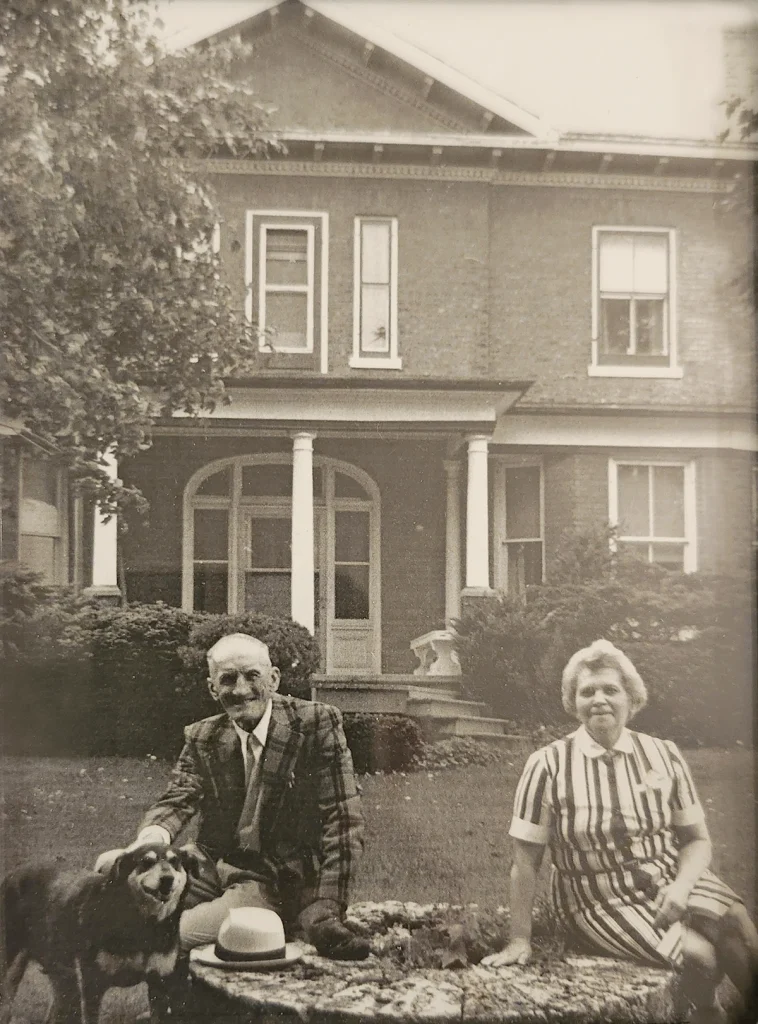
Alf and Lena Graham, 1962, in front of Belmont House
Lena never described herself as a farmer, but we can agree that she too was a farmer. To say their income was modest would be an understatement, and except for their bedroom suite and the player piano which are still in our possession, everything in the house was a hand-me-down.
As a family, we lived in restricted sections of the dwelling: the large kitchen with its cook stove, the east double parlours, and three of the 5 bedrooms on the upper level. In terms of facilities, we had access to one bathroom with a tub, sink and toilet, a second bathroom with a shower, toilet and sink, and a 2-piece washroom on the main level. The water supply had two sources. Drinking water came from the ever-flowing artesian well to the east of the house, water that was visible in a cement tank in the floor of the basement, and soft water was collected in an underground cistern, and as its level depended totally on weather patterns, bathing was allowed only once a week, and showers were quick!
What experiences do I recall from my time at Belmont, 1946 – 1967 when I finished university, and moved to Germany, then Ottawa. . .?
Let me begin in the basement, where there was an octopus of a furnace, barely able to heat the 15-room house, fired by wood chopped by my father, or at other times fired by coal delivered by his younger brother, George Wesley Graham. I still recall winter mornings curled up in my feather tick in bed, hearing the rumble of wood being added to the furnace at 6 a.m., when my father started his day. The basement was cool enough to store a few apples, as well as the annual harvest of potatoes and carrots.
On the main level the kitchen had 8 doors: the pantry, (with its dumb waiter) the back stairs, the hallway, the cellar, the anteroom, the back door, the maid’s stairway, and a coat closet. It was here that the kitchen table, which had 4 leaves, hosted over a dozen hungry helpers at the time of harvest, or family gatherings. It was the room where we as children did our homework, and where we all gathered daily at the radio to hear Gordon Sinclair on CFRB. We did not live in the southwest room at all; it was a playroom or storage area. In the east parlour was the piano, the dining table for occasional use, and after 1963, a television – black and white, of course.
The central grand staircase area was not useful except as transit space, and where children produced costumed plays and musical fantasies. The main front door was not used more than three times a year.
I failed to mention “the back rooms” of the house which were perhaps meant as the summer kitchen, but in fact served as storage areas for machinery, apple boxes and discarded items kept “just in case.” The original 1898 kitchen cupboards, painted bright red, had been moved there, and I own one of them to this day.
My parents once hosted a New Year’s Eve party and dance, using the double parlours on the east side of the house, with a small instrumental group providing the dance tunes. In 1970, my sister’s wedding reception took place in these large rooms. A decade later, my father’s health forced him to abandon farming after 40 years, and pass what remained of the property to Heather Griffin and her family.
In 1986, Alfred and Lena moved to a bungalow on Mill Street south at the end of August, where he died only 7 weeks later. Lena lived in the village and was active with the NVDHS for another 20 years.
While living at Belmont, we were always aware that we were custodians of a slice of Newcastle history, the more so because my father had been Reeve of the area before he was 35. We enjoyed the swimming hole in Wilmot Creek, and I learned to skate on the former fishponds. We caught rainbow trout from the stream, we had fresh produce from the half-acre garden and especially enjoyed the flavour of harvest apples from the single tree in the garden. The external buildings consisted of a chicken house where I collected eggs daily, a driving shed for all the implements, and a two-tier barn, the newer section having been built by my father between 1939 and 1946.
What a privilege it was to grow up with an awareness of things past and things to come, while helping to preserve and gradually improve a small element of Canadian heritage.
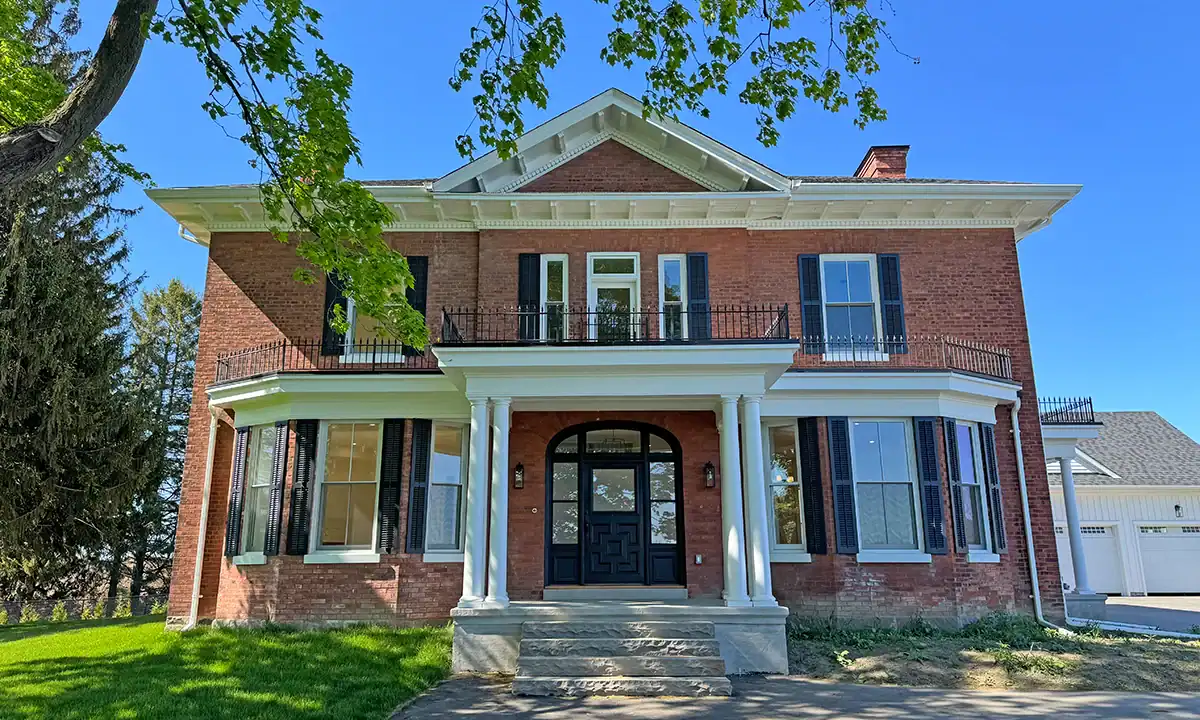
On October 22, 2025, the NVDHS was privileged to host JJ Maclellan, Project Manager for Manorville Homes to talk to us about the two-year restoration and renovation of the heritage-registered Belmont House in Newcastle, Ontario. Thank you to JJ for sharing his slide show with us, and for sharing this remarkable project our members.
NVDHS presents speakers JJ Maclellan (Project manager for restoration) and Fred Kimball Graham, former Belmont House resident.
Wednesday, October 22, 2025, at 7 p.m. Newcastle Community Hall
Please join us for a special community event at the Newcastle Community Hall, as we share the fascinating story of the Belmont House and its restoration.
Learn about the home’s history, the preservation efforts that brought it back to life, and its place in our community’s heritage. All are welcome!
Free admission, and free refreshments to be provided.
Please RSVP so we can provide adequate seating and treats!
Saturday, April 12, 2025 at 11 a.m. Historical Room, Newcastle Community Hall
Find out what we’ve been doing for the past year
Elect the 2024-2025 Board of Directors
Participate in our fun and informative Show and Tell
Enjoy a light lunch afterwards
The meeting portion will be short and then it will be on to the fun of sharing our interesting items of historical interest. Found some mysterious items when cleaning out the basement at Grandma’s? Or something amazing at a garage sale last summer? Bring it in and share at our very own Newcastle mini “Antiques Roadshow.”
Free light lunch.
Hope you can join us! (Please let us know by Friday, April 11 at 4 p.m. if you’ll be joining us for lunch too, so we can plan appropriate food quantities)
Approve the waiving of a financial audit or review engagement for 2025: “Resolved, that pursuant to section 76(2)(b) of the Ontario Not-for-Profit Corporations Act, which permits a not-for-profit corporation other than a public benefit corporation to not appoint an auditor and to not have an audit or a review engagement in respect of the corporation’s financial year if the corporation had annual revenue in that financial year of $500,000 or less or such other prescribed amount, the Newcastle Village and District Historical Society not appoint an auditor and not have an audit or a review engagement in respect of its 2025 financial year.”
Amendment to by-laws, granting corporate membership to any corporation that donates $100 or more per year: “Resolved, to amend Bylaw Article 8.01.3 Corporate members to read “Corporate Members shall be individuals representing a corporation, who have paid for a Corporate membership in the Society or who have donated $100 or more to the society.“
Resolution to elect the 2025 Board of Directors: “Resolved, that the Association elect the following directors as presented by the Nominating Committee pursuant to Bylaw Section 2.01: Don Brown, James Breech,Paddy Duncan, Roger Farrow, Greg Forget, Sarah Fournier, Fred Graham, Noel Gordon, Brian Jose, Marilyn Kent, Sher Leetooze, Sandra Long, Peter Martin.”
Notice is hereby given of motion to amend by-laws at the Annual General Meeting, April 12, 2025, 11 a.m. at the Newcastle Village and District Historical Society, 20 King Ave. W., Newcastle, ON.
By-law 8.01 Members to be amended to add phrase in italics.
3. Corporate Members shall be individuals representing a corporation, who have paid for a Corporate membership in the Society or who have donated more than $100 in a year.
Explanation: Amendment to the by-law adds membership in the society as a benefit/privilege for those corporations that make donations of $100 or more in a year.
We’d like to give a shout out to these local businesses and individuals for their generous donations to support the work of the Newcastle Village and District Historical Society. If you are interested in donating or becoming a member you can do that online or drop by to see what we are all about, any Saturday or Tuesday morning, 9:30 to noon.
We use cookies to ensure that we give you the best experience on our website. If you continue to use this site we will assume that you are happy with it.
You can revoke your consent any time using the Revoke consent button.